
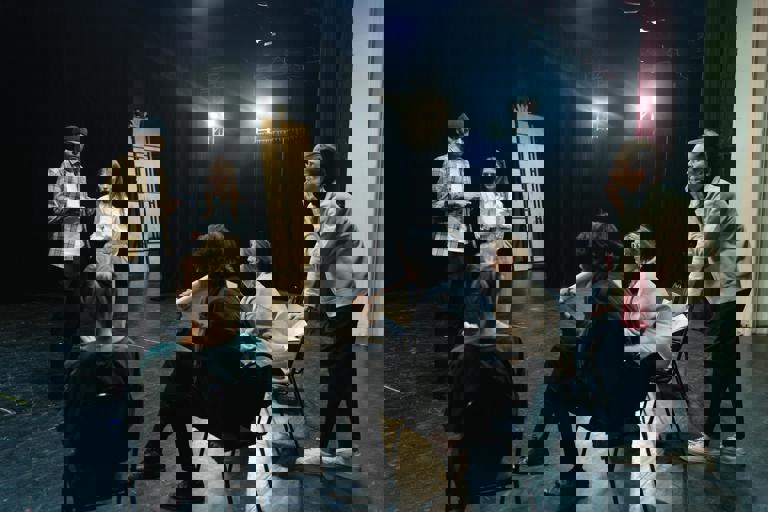
An ambitious underground theatre collective is making waves by reviving a neglected piece of 19th-century drama, imbuing it with strikingly modern relevance. The troupe, known for its unconventional approaches, has chosen to resurrect "The Boundless Hour," a largely forgotten Victorian play. This production has set out to explore contemporary parallels, determined to show audiences that age-old themes can resonate vividly in today’s world when presented through a fresh lens.
The original script of "The Boundless Hour," penned in 1872 by playwright Edith Spencer, was rarely staged during its own era and has since faded into obscurity. Its rediscovery by the company’s dramaturg, Alice Redfern, sparked a flurry of creative brainstorming. Redfern recalls, "We found in Spencer’s words a raw energy and moral complexity, quite revolutionary for her time, begging for reinterpretation by a modern ensemble."
Adopting a site-specific approach, the production has eschewed traditional theatres for unexpected urban spaces, including former warehouses and tucked-away basements. By placing the audience close to the performers, director Jon Harvey says, "We break down barriers – the setting becomes woven into the narrative, intensifying the impact of each scene." This intimate staging has been credited with drawing theatergoers who might otherwise bypass established venues.
Modernization has been a deliberate and well-considered aspect of this revival. While original Victorian dialogue remains much intact, the ensemble weaves in contemporary language and technology – for example, handwritten letters in the story are now sent as text messages, and gas lamps are swapped for flickering smartphones. Costume choices, similarly, blend period silhouettes with present-day fashion, reflecting the production’s thematic melding of eras.
The cast, a mix of seasoned professionals and rising theatrical talents, has found the process both demanding and rewarding. Lead actor Marcus Bainbridge notes, "Portraying a character rooted in Victorian social norms, yet living out dilemmas familiar to today’s audiences, is a unique challenge. We've had to research the social conscience of the time while remaining true to present-day sensibilities." Their dedication has received critical praise for its subtle emotional layering.
Audience response has exceeded expectations, with many performances selling out and lines stretching around the block. Surveys conducted by the production team revealed that nearly 60% of attendees were younger than 35, a demographic often underrepresented at plays featuring historical material. Word-of-mouth popularity and social media buzz have contributed to fresh enthusiasm about the play’s themes of freedom, repression, and personal agency.
The creative team has also sought community engagement by hosting workshops and post-performance discussions. Local schools have been invited to attend matinees, providing students with unique opportunities to explore how history and art intersect. Chloe Jennings, a secondary school teacher, shared, "Our students are seeing firsthand that the struggles and aspirations of the past are not so distant from their own."
This underground production has provoked thoughtful conversation about the role of lesser-known works in the cultural canon. Theatre critic Ben Walters commented, "Reviving plays like ‘The Boundless Hour’ challenges us to reconsider what we value and remember. By updating its context, this company exposes a new richness in voices previously overlooked by the mainstream stage." Such efforts have sparked wider interest in the rediscovery of historical plays.
Financially, the production exemplifies resourcefulness. Relying on crowdfunding and support from arts grants, the collective has kept ticket prices accessible without sacrificing production quality. Producer Kate Fielding explains, "We wanted to remove every possible barrier to attendance. Theatre should feel open to everyone, and our model shows it can work outside conventional commercial structures." This has fostered a diverse and spirited audience base.
Looking ahead, the team hopes to inspire other theatre-makers to dig into historical archives in search of neglected masterpieces. Plans are underway to document the entire creative process for an upcoming short film, potentially giving the project a second life online. Such initiatives reflect an ambition not just to restage a play, but to invigorate theatre culture with bold, archival curiosity and contemporary flair.
As the run approaches its final weeks, there is palpable momentum among cast, crew, and patrons alike. The success of this unconventional revival suggests that, far from being relics, forgotten theatrical works can be potent vessels for dialogue and reflection. The collective’s innovative approach may well influence the evolution of theatre in GB, as artists and audiences alike seek meaningful, boundary-pushing experiences outside the mainstream stage.